
Peter W. Flint wants to read Empire of Silence by Christopher Ruocchio
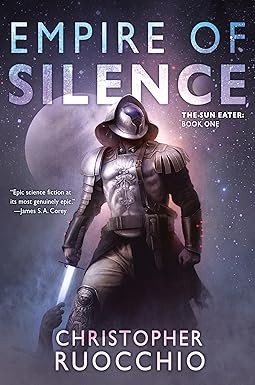
It was not his war. On the wrong planet, at the right time, for the …
Run club rec

Landscape designer in the NC Mountains and Piedmont | Proprietor of KALEIOPE Environmental Design | Autodidact Polymath | Certified Meteobierologue | Avid reader | Reluctant SysAdmin
This link opens in a pop-up window
Success! Peter W. Flint has read 16 of 15 books.
It was not his war. On the wrong planet, at the right time, for the …
Run club rec
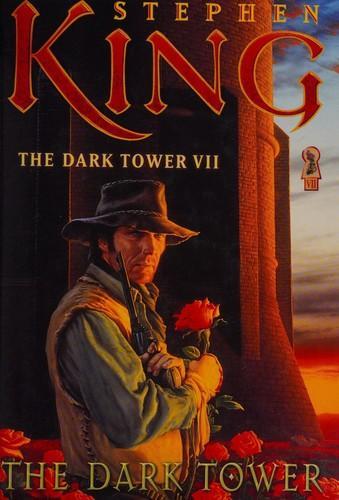
The Dark Tower VII: The Dark Tower is a 2004 fantasy novel by American writer Stephen King. It is the …
The Dark Tower VII: The Dark Tower is a 2004 fantasy novel by American writer …
So much you did and so much more you would have done, aye, and all without a check or qualm, and so will the world end, I think, a victim of love rather than hate. For love’s ever been the more destructive weapon, sure.
— The Dark Tower VII: The Dark Tower by Stephen King (Page 141)
No argument with this sentiment.
The Dark Tower VII: The Dark Tower is a 2004 fantasy novel by American writer …
Do any of us, except in our dreams, truly expect to be reunited with our hearts’ deepest loves, even when they leave us only for minutes, and on the most mundane of errands? No, not at all. Each time they go from our sight we in our secret hearts count them as dead. Having been given so much, we reason, how could we expect not to be brought as low as Lucifer for the staggering presumption of our love?
— The Dark Tower VII: The Dark Tower by Stephen King (Page 136)
It’s always in the heat of plot development where you get hit the hardest.
The Dark Tower VII: The Dark Tower is a 2004 fantasy novel by American writer …
O discordia
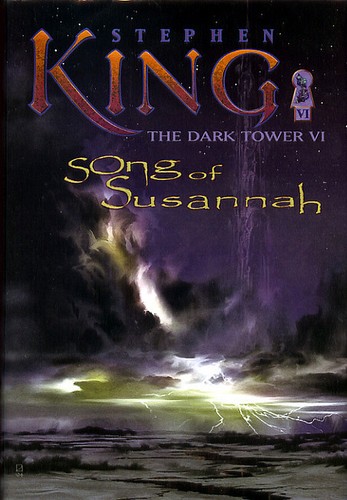
The next-to-last novel in Stephen King's seven-volume magnum opus, Song of Susannah is at once a book of revelation, a …
Four lives are drawn together in a sweeping, panoramic new novel from Richard Powers, showcasing the Pulitzer Prize–winning author of …
The next-to-last novel in Stephen King's seven-volume magnum opus, Song of Susannah is at once a book of revelation, a …
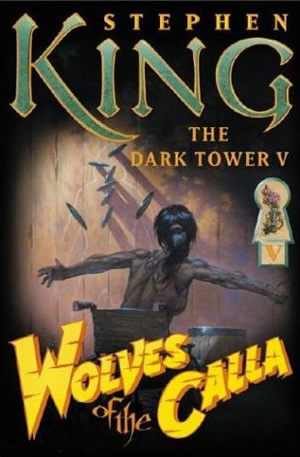
Wolves of the Calla continues the adventures of Roland, the Last Gunslinger and survivor of a civilized world that has …
Maybe the question instead is, “What is my Tower? And what is my Rose?”
Maybe the question being asked is, “Do we follow the Way of the Tower, or the Way of the Rose?” Maybe we’re following both. Maybe both are right and neither is wrong.
Wolves of the Calla continues the adventures of Roland, the Last Gunslinger and survivor of …
Content warning Commentary for those who’ve already read
That was what all five of them felt most strongly (for Oy felt it too): the sense of something that was wonderfully and beautifully alright.
— Wolves of the Calla (The Dark Tower, #5) by Stephen King (Dark Tower (5)) (Page 182)
Roland and ka-tet have gone todash in New York to see the rose in the vacant lot on Second and Forty-Sixth St. This is the first time seeing for everyone but Jake, who discovered it in the course of being drawn back into Roland’s world in Book 3.
Here we begin to understand the polarity between the Bright and Dark Towers introduced in Book 4. As Roland comes to understand through his experience, the rose and the tower are the same, yet separate. The rose, fragile, resilient, tenacious, surviving against the odds amongst a field of towers in New York, juxtaposes the monolithic eternity of the Dark Tower. Both are nexuses of reality, points of organization, but the rose speaks of allurement and beauty, while the tower represents physical forces such as gravity and magnetism. The Tower marks the way of atonement, the Rose that of forgiveness.
In terms of contemporary mythic imagery, the rose is an illustration of deep okayness. There are other terms for this: contentment, bliss, zen states, etc. It’s a feeling I usually access in meditation but it’s also a feeling that’s always there within each of us. I had it at the beach once with a friend and her kids. It says everything that’s happened, the suffering, the triumph, the anger, the sadness, the joy, the little acts of kindness that didn’t seem to matter have all led you to this moment. It is a sense of wholeness, of fitting in, of belonging to that particular time and place.
Like the rose, this feeling is fragile. Grasped too tightly, it breaks. There are many out there, and darker dimensions of the self in here, threatened by such beauty and will do everything to destroy it, for what is the point of striving toward Conditional Love when unconditional love is immediately present? The Rose is not something to be possessed, but something that simply is, that animating force underneath the sea of being present in plants and animals and people and maybe rocks and stars that keeps us moving even when it becomes too much, that will find somewhere else to grow even when it’s destroyed.
Recognizing this space around the Rose and preserving it becomes the second task in the quest for the Dark Tower. The Rose provides meaning for the sacrifices to come.
Wolves of the Calla continues the adventures of Roland, the Last Gunslinger and survivor of a civilized world that has …
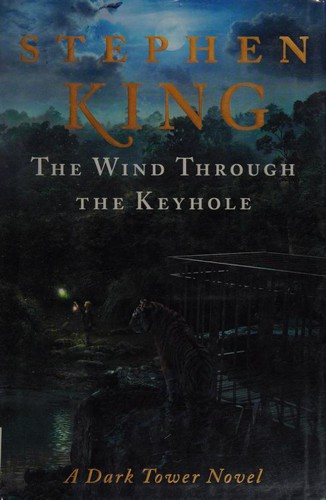
Sent by his father to investigate evidence of a murderous shape shifter, a "skin man," …
Content warning Personal commentary that might contain spoilers
This was a quick and refreshing break from the saga to come that will have all but one beloved character dead at the end. And yet I still found myself crying in the shower this morning as I unpacked its thematic content.
There are three layers to this story. The first is an interlude between the formative events of the Dark Tower ka-tet and their journey into End World that comprises the last three novels. The second is a portrait of Roland’s development into a full-fledged gunslinger. The third is a fairy tale that ties the Roland of youth and Roland as adult together. The first layer takes up only 10% of the narrative, but becomes fundamental to the reader’s understanding of Roland as dinh of his ka-tet, and why his companions will sacrifice themselves for the quest at large when the time comes.
The second layer sees Roland, still a teenager, grieving his role in his mother’s death and sent to the outskirts of Gilead to deal with a Skin Man, a murdering shapeshifter. Here he meets a priestess who knew his mother in the context of healing from her indiscretions and recovering her mental health, someone who knew her as a woman and not in her societal role. While this encounter feels tangential to the arc of the Skin Man narrative, it is pivotal to Roland’s character development as a whole.
The third layer is introduced as Roland comforts a young boy who has lost his father to the skin man, now an orphan. He tells the story of the Wind Through the Keyhole, how the boy Tim was lured into the Endless Forest to save his mother’s sight. The themes of this story revolve around spousal abuse, but for Roland I think it is really being told as a way to reclaim his childhood innocence, returning to a time when his own mother would tell him bedtime stories, before life got complicated and tragic. Tim survives the challenges of the wilderness, retrieves his magical elixir and his mothers sight, enabling her to kill his stepfather with her dead husband’s axe. Figuratively, for Roland, Mother and Son are reunited against the patriarchal model of the society they must exist within.
Roland finishes his fairy tale and returns to the plot of the skin man. He is flushed out of hiding and dealt with in the gunslingers way. There is probably a theme to explore here in the context of shapeshifting and violence, but these are not resonating with me this go round. In the aftermath of the tale, Roland approaches the priestess to see about taking in the orphaned boy. She agrees but also hands Roland a letter from his mother. In this letter, she confesses to ending her recovery prematurely, to returning to Gilead under dark influences, and to knowing the outcome of this decision: death at the hand of her only son. It is a foretelling that Roland receives only after the deeds are done. He takes the news in with the appropriate grief and tears, alluding to the last lines of her letter that he spent years and years tracing over before he came to terms with them.
The story returns to its first layer, adult Roland and ka-tet passing the time with a tale while waiting out a storm. Here we learn those last lines of the letter, asked privately by Susannah, herself in the early stages of pregnancy (though as yet unaware of it). We discover that despite knowing her demise, Gabrielle Deschain stepped onto the wheel of ka and allowed events to take their course. In the distortion and confusion of much larger circumstances, her son ended her life and proceeded along his own path of inner suffering. Within all this knowledge, she asks,
“I forgive you everything, do you forgive me?”
Only through and after the countless years of turmoil, resignation, and the telling of the tale, Roland finds he does, and this brings him great joy.
This Atonement with the Mother, is a theme I’ve not seen anywhere else, at least not in the fantasy and fiction I’ve read over the years. In most story-telling, the Mother is the source of safety and shelter, or inverted into the object to be restored. She is not the source of suffering but its salve. The Father tends to be the cause of conflict and object of atonement, as Joseph Campbell argues in The Hero with a Thousand Faces. It’s another example of King’s ability to iterate over familiar themes through his willingness to take on the darkness of the human heart. Mothers can also cause harm, however unintentional or driven by subconscious processes. This was my childhood experience. This story, as stories are meant to do, revealed to me that my mom and I have walked the path of forgiveness and formed an enviable adult relationship.
Sent by his father to investigate evidence of a murderous shape shifter, a "skin man," …
First time including this in series chronology.